Exhibition time: 24-26 March, 2027 Shanghai, China
 中文
中文
Exhibition time: 24-26 March, 2027 Shanghai, China
中文

As the challenge of saline-alkali soil continues to threaten agricultural productivity worldwide, integrated biostimulant technologies are emerging as one of the most effective solutions for saline-alkali soil remediation, restoring degraded farmland, and recovering long-term soil productivity.
Recently, the saline-alkali soil remediation technology developed by Qingdao Seawin Biotech Group received both national and provincial awards in China, earning recognition from authoritative institutions at the highest levels.
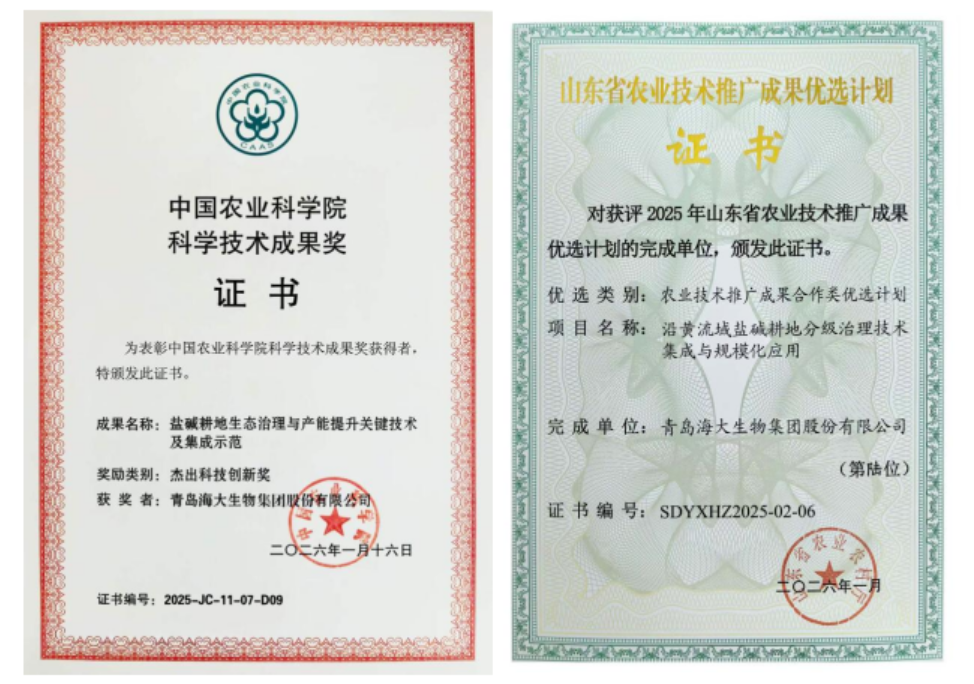
This achievement highlights the growing importance of marine-derived biostimulants and beneficial microorganisms in improving saline-alkali soil health, reducing salt stress, enhancing nutrient availability, and increasing crop yields in saline-alkali soils.
Saline-Alkali Soil: A Major Challenge to Global Agriculture
According to the FAO, more than 1.4 billion hectares of land worldwide are affected by salinization and alkalization.
Saline-alkali soils create a range of serious problems for crop production, including:
Low seed germination rates and poor crop establishment
Nutrient imbalance and reduced fertilizer efficiency
Soil compaction and poor aggregate structure
Declining microbial activity in the rhizosphere
Low and unstable crop yields
This challenge is particularly severe in arid and semi-arid regions, as well as in coastal agricultural areas, where saline-alkali soil degradation has become a major threat to global food security.
The two award-winning achievements represent the culmination of Qingdao Seawin Biotech Group’s long-term commitment to saline-alkali soil improvement and saline-alkali soil remediation.
1. Key Technologies and Integrated Demonstration for Ecological Restoration and Productivity Enhancement of Saline-Alkali Farmland
Recipient of the China Agricultural Science and Technology Innovation Award
This project overcame the limitations of conventional soil amendment approaches that focus on short-term correction while neglecting long-term soil health.
Seawin developed an integrated remediation system based on:
Dual-seaweed-derived biostimulants
Biosynthesized functional biostimulants
Salt-tolerant beneficial microbial inoculants
This synergistic approach delivers three major benefits:
Desalinization and soil structure improvement
Restoration of soil microbial ecology
Stable and increased crop productivity
The technology effectively addresses key challenges in saline-alkali soils, including weak seedling establishment and unstable yields.
2. Integrated Graded Management Technology and Large-Scale Application for Saline-Alkali Farmland Along the Yellow River Basin
Selected for the Shandong Provincial Priority Program
This project developed scientifically tailored nutrition and soil management programs according to different degrees of saline-alkali soil severity in the Yellow River Basin.
The integrated solution not only reduces salinity and improves crop tolerance to saline-alkali stress, but also ensures balanced nutrient supply throughout the crop cycle, enabling stable and high yields under adverse soil conditions.
1. Dual-Algae Biostimulant Technology
This proprietary technology utilizes Seawin’s patented Dual-Algae Enzymolysis-Fermentation Coupling Extraction Technology to integrate a wide range of bioactive compounds from both green algae and brown algae, including: Alginic Acid, Seaweed polysaccharides, Natural osmoprotectants. These naturally derived components play a critical role in saline-alkali soil remediation by:
Enhancing crop tolerance to salt stress and other abiotic stresses
Stimulating root development and nutrient uptake
Promoting the formation of stable soil aggregates
Reducing surface salt accumulation in saline-alkali soils
2. Biosynthesized Functional Factor and Microbial Synergistic Technology
This innovative technology combines the biosynthesized stress-resistance factor APAA with salt-tolerant beneficial microorganisms to create an integrated solution for saline-alkali soil improvement.
The synergistic system delivers multiple functions simultaneously:
Enhancing crop resistance to salt and environmental stress
Reducing salt damage
Increasing soil fertility
Improving soil structure
Restoring soil microbial ecology for long-term soil health
3. Graded Management and Precision Adaptation Technology
This technology establishes a multidimensional evaluation system for saline-alkali soils and develops customized saline-alkali soil remediation programs tailored to specific soil conditions in diverse environments, including the Yellow River Basin and coastal saline-alkali soils.
1. Application in Saline-Alkali Cotton Fields in Xinjiang
Cotton grown in the saline-alkali soils of Xinjiang is particularly vulnerable to salt stress during the germination and seedling stages, when root tissues are still tender and the plants have limited tolerance to saline-alkali conditions.
After application of Seawin’s integrated saline-alkali soil treatment program through drip irrigation, cotton growth showed significant improvement, as illustrated below.
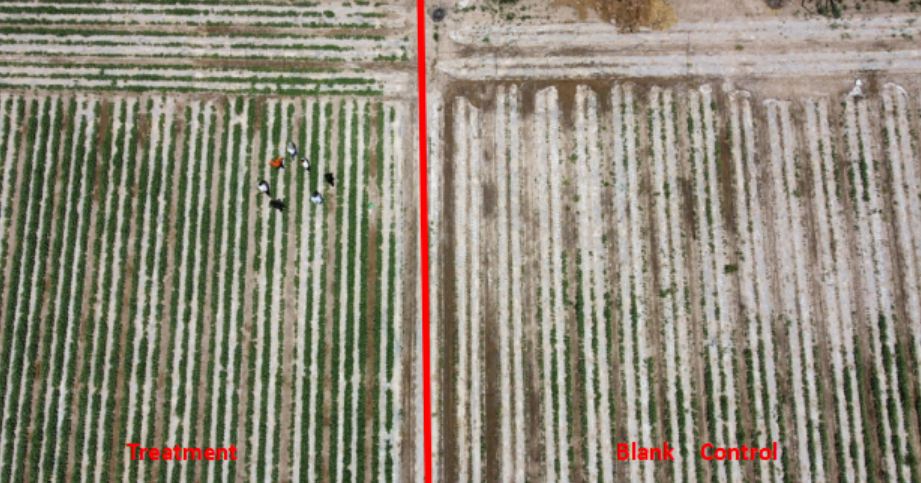
The treated cotton showed higher emergence rates, stronger tolerance to saline-alkali stress, fewer dead seedlings, more developed root systems, and healthier stems and leaves, establishing a solid foundation for high yields.
2.Coastal Landscaping Application in Qingdao
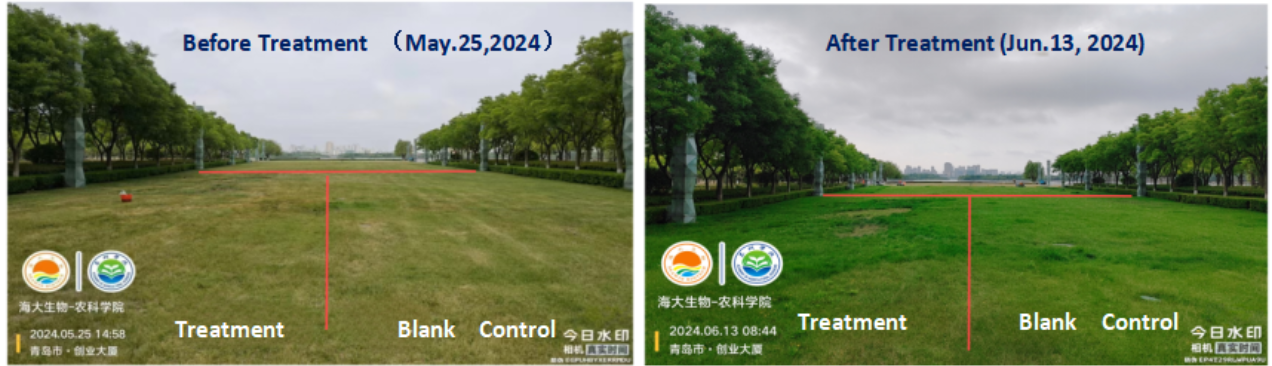
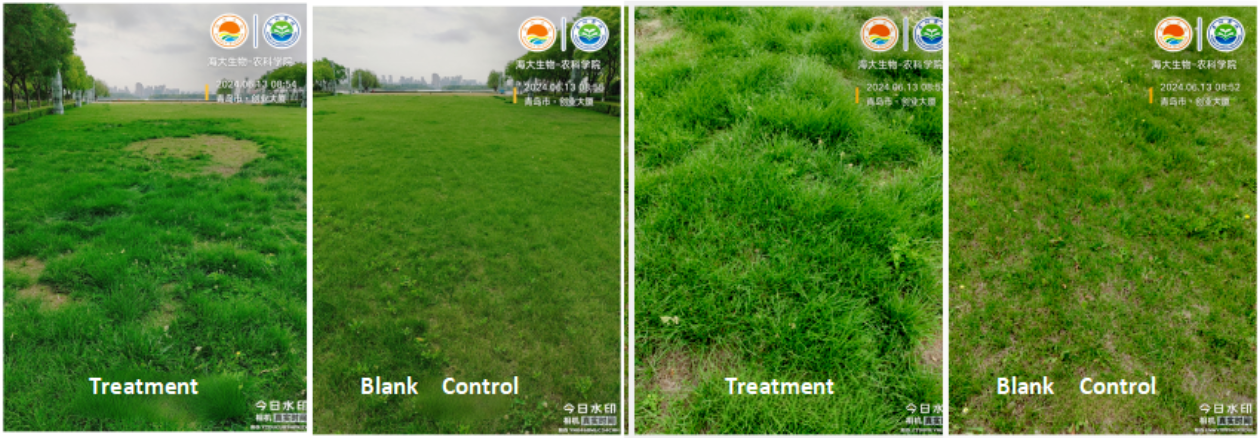
In the coastal saline-alkali areas of Qingdao, this technology successfully improved the rhizosphere environment of urban landscaping plants, promoted root development, and enhanced overall plant vigor and landscape quality.
Traditional approaches to saline-alkali soil remediation mainly rely on chemical amendments such as gypsum, along with intensive irrigation and salt-leaching practices. While these methods can reduce salinity and sodicity, they are often costly and provide limited support for restoring soil biological activity and long-term soil health.
Biostimulants and beneficial microorganisms offer a complementary solution by working at both physiological and ecological levels. They help crops and soils recover through multiple mechanisms, including:
Enhancing osmotic adjustment in plants
Activating antioxidant defense systems
Stimulating root growth and development
Improving nutrient uptake and utilization
Rebuilding beneficial rhizosphere microbial communities
By addressing both plant stress tolerance and soil ecosystem restoration, biostimulants have become an important component of modern saline-alkali soil management and a valuable complement to conventional remediation practices.
As global agriculture faces increasingly severe challenges from saline-alkali soils, drought, and climate change, the integrated technology developed by Qingdao Seawin Biotech Group combining Biostimulants, Biosynthesized functional factors and Beneficial microorganisms, offers a powerful and sustainable solution. It enhances crop stress tolerance and yield in the short term, while restoring soil ecology and improving soil health over the long term.
The recent national recognition of this technology further demonstrates that biotechnology-driven solutions are opening new pathways for global saline-alkali soil restoration and sustainable agricultural development.
Source:AgNews


WeChat Subcriber






WeChat Subcriber
 CCPIT Sub-Council of Chemical Industry
Address:Bldg. No.16, Block 7, Hepingli, Beijing 100013, P.R. China Zip code:100013
Tel:0086-10-84255960
E-Mail:zhengyingying@ccpitchem.org.cn
© 2009-2025 CCPIT Sub-Council of Chemical Industry Website visits:2810212 Private Policy
Private Policy contact us 京ICP备17065506号-14 京公网安备11010102001043号